
Training Needs Direction, Not Rigidity
A good training plan should point you somewhere.
It does not need to control everything.
This is where climbers often get stuck. One plan says to hangboard. Another says to lift. Another says to board climb. Another says to do mobility, antagonist work, core, conditioning, and five different progressions before you even touch the wall.
The result is not always better training.
Sometimes it is just more training.
For climbers, the goal is to improve climbing performance. That means supplemental training should support the climbing, not bury it.
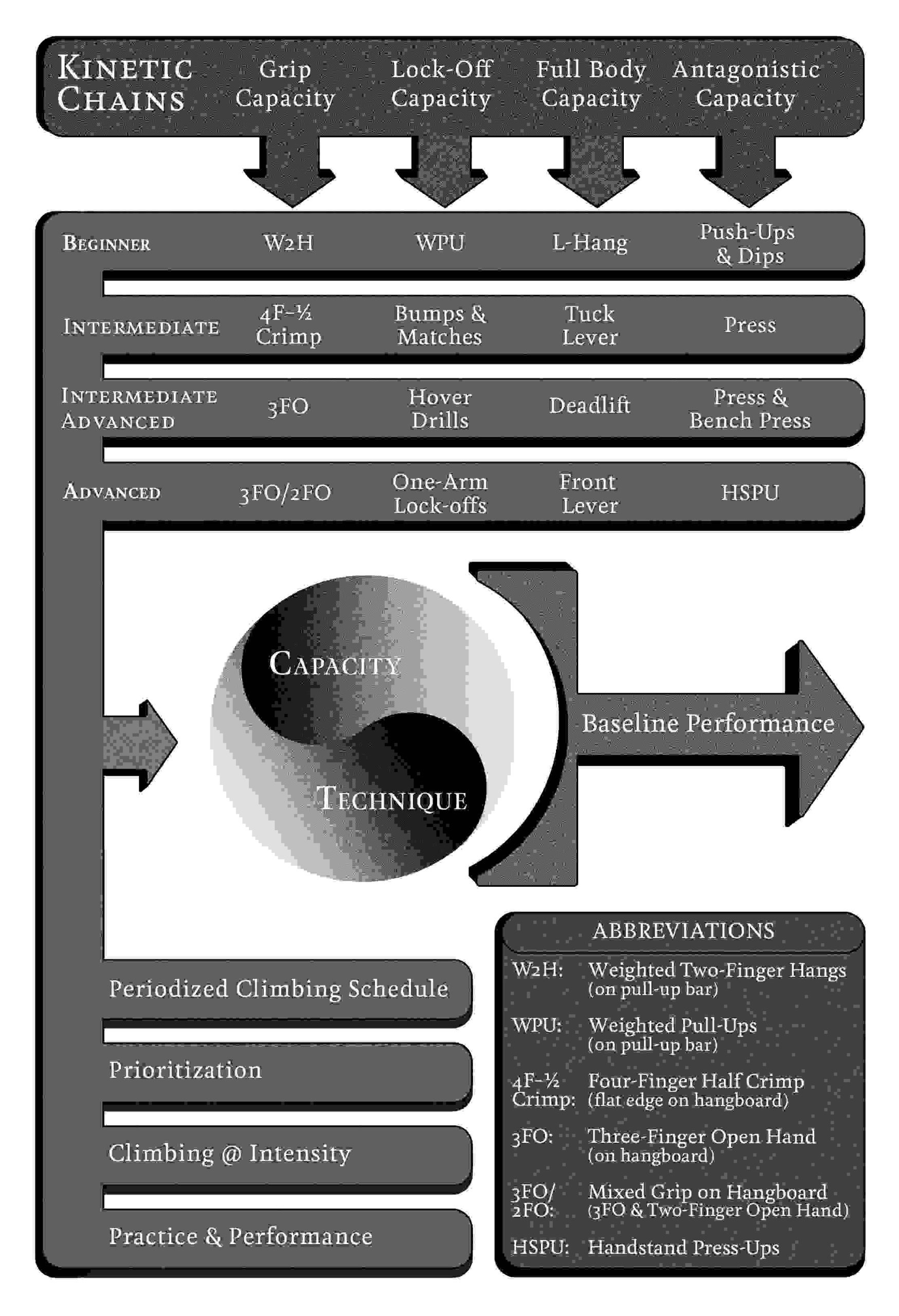
A simple way to begin is by choosing a small number of movements that transfer well to climbing. Grip strength, lock-off strength, and whole-body tension all have a direct relationship to climbing performance. Antagonist training is also useful because it helps balance the repeated pulling demands of the sport.
But that does not mean every climber needs a long list of exercises.
One movement per category is usually enough. For some climbers, even two total movements may be better if that is the difference between training consistently and training sporadically.
Consistency matters more than complexity.
A brief workout repeated over time will usually do more for a climber than a long, exhausting workout that competes with climbing quality. The process is what creates the adaptation, not any single heroic session.
That is the “less is more” principle.
Less does not mean easy.
It means focused.
A supplemental workout should be short enough to recover from, specific enough to matter, and repeatable enough to become part of the climber’s actual life. More than four supplemental movements or more than two workouts per week can easily begin to interfere with climbing performance, though every climber’s tolerance is different.
This is why training progressions matter.
Beginner, intermediate, and advanced movements are not labels of status. They are simply ways of organizing how training changes over time. A climber might begin with weight training to build whole-body strength, then later use that strength to work toward more advanced gymnastic positions like front lever progressions.
The order is less important than the purpose.
Training needs enough repetition to create adaptation, but not so much sameness that it becomes monotonous. Too little variation can lead to stagnation or overuse. Too much variation can scatter the training effect before it has time to take hold.
The goal is to stay on a path long enough for it to work, while remaining flexible enough to adjust when it stops working.
Climbing itself can also be used this way.
Not every training strategy has to happen off the wall. Board climbing on a MoonBoard, Kilter Board, or Tension Board can emphasize strength and power. Bouldering can build strength and power that later supports route climbing. Route climbing can maintain endurance while a climber emphasizes strength elsewhere.
These are climbing-only strategies, but they still follow the same principle:
Choose the work that supports the primary objective.
If your main goal is bouldering, board climbing may help emphasize strength and power while keeping the work close to climbing. If your main goal is route climbing, a period of bouldering may help raise your strength ceiling while endurance is maintained through the rest of your schedule.
There is no single correct combination.
The best plan depends on your climbing history, training history, goals, available resources, season of the year, and life outside climbing. A good program has to respect all of that.
Especially life outside climbing.
Stress matters. Sleep matters. Work matters. Motivation matters. The body does not separate training stress from every other kind of stress as neatly as we sometimes pretend. A plan that looks good on paper may still fail if it ignores the person who has to recover from it.
That is why the best training plans are structured, but not brittle.
Early on, a simple system is usually enough: choose a few useful movements, err on the side of moderation, repeat them consistently, and protect the quality of your climbing. Over time, as you become more experienced, the plan can become more dynamic.
But the foundation remains the same.
Train with enough direction to improve.
Adjust with enough humility to keep improving.
Send me an email, and I'll get back to you as soon as I can.